Hollow Markets, Heavy Losses: How Multi-Agent Portfolios Drain Their Own Liquidity After Hours

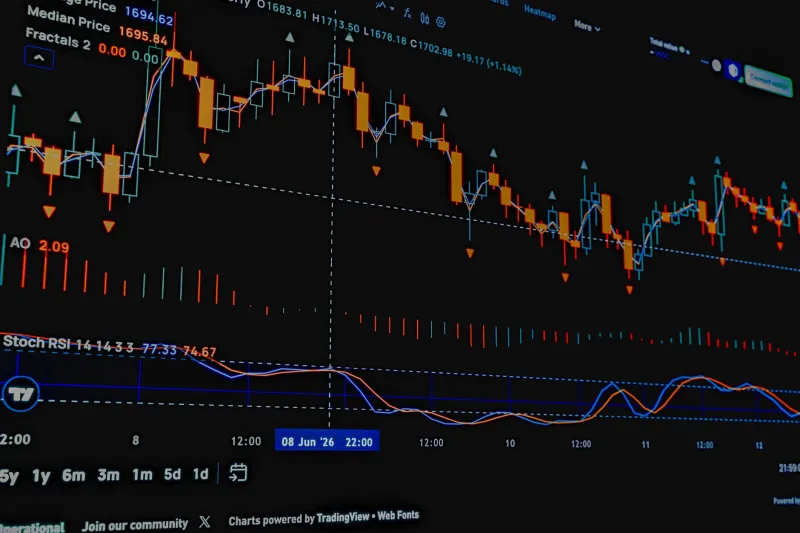
Photo by Photo by Y K on Unsplash on Unsplash
There is a particular kind of trap that only reveals itself after the closing bell, when US equity desks have gone dark and crypto order books thin to a fraction of their midday depth. For traders running multi-agent portfolio systems, this is the hour when a seemingly well-constructed strategy can quietly cannibalize itself — not because the agents malfunction, but because they function precisely as designed.
The problem is not execution failure. It is execution success in the wrong conditions.
What the Order Book Looks Like at 2 a.m. Eastern
Cryptocurrency markets operate continuously, but liquidity does not. Volume data across major pairs consistently shows a pronounced trough between roughly 11 p.m. and 6 a.m. Eastern Time — the window when US institutional desks are offline, European participants have not yet arrived in force, and Asian session activity is concentrated in a narrow set of pairs that may not overlap with a given portfolio's holdings.
During peak hours, a liquid pair like BTC/USDT might sustain several million dollars in visible order book depth within a 0.5% spread. In the overnight trough, that same pair can see depth contract by 60 to 80 percent. Mid-cap altcoins — frequently targeted by diversified agent portfolios for their volatility premium — can become nearly illiquid, with spreads widening to levels that render any theoretical edge economically meaningless before fees are even calculated.
This is not a bug in the market. It is a structural feature. The issue arises when agent systems treat low-volume hours as functionally equivalent to high-volume ones.
How Nine Agents Become Nine Competing Consumers
A single trading agent operating in thin conditions is a manageable problem. It encounters limited depth, adjusts order sizing, and either waits or accepts a wider spread. The friction is real but bounded.
Nine agents operating under a coordinated portfolio architecture introduce a compounding dynamic that is qualitatively different. Each agent is designed to identify and act on opportunity. In normal conditions, their combined activity represents a fraction of total market volume — small enough that their collective footprint barely registers. But in low-volume hours, the math inverts.
Consider a portfolio where four agents independently identify a momentum signal on a mid-cap token with a daily average volume of $8 million. During peak hours, four simultaneous market orders totaling $400,000 represent roughly 5% of hourly volume — noticeable but absorbable. At 2 a.m. Eastern, when hourly volume may have dropped to $300,000, those same four orders represent more than 130% of available hourly flow. The agents are not trading into a market. They are the market — and they are moving it against themselves.
The result is a specific form of self-inflicted slippage. The first agent's order begins consuming the order book. By the time the second, third, and fourth orders execute — even milliseconds later — the available depth has shifted. Each subsequent fill occurs at a progressively worse price. The portfolio's net execution cost bears no resemblance to the price the strategy anticipated when the signal was generated.
The Visibility Paradox
One of the genuine advantages of autonomous agent systems is informational speed. Agents can parse on-chain data, monitor off-exchange signals, and respond to changing conditions faster than any human trader. In competitive, liquid markets, this speed advantage translates directly into better fills and tighter execution.
In thin markets, that same speed becomes a liability. When multiple agents simultaneously perceive the same signal — which is likely if they share data infrastructure or are trained on similar inputs — their coordinated response arrives at an order book that cannot absorb it. The agents' ability to act faster than the market can replenish depth means they execute into a vacuum of their own making.
This is the visibility paradox: the clearer the signal, the more agents respond to it; the more agents respond, the worse the collective execution. The strategy's strength becomes the mechanism of its degradation.
Volume Pattern Analysis and the Case for Temporal Segmentation
Addressing this problem requires treating time-of-day liquidity as a first-class variable in portfolio architecture, not an afterthought.
Historical volume analysis across US trading hours reveals consistent patterns that can inform agent scheduling. The highest-liquidity windows for USD-denominated pairs typically cluster around the New York open (approximately 9 a.m. to 11 a.m. Eastern) and the London-New York overlap (roughly 8 a.m. to noon Eastern). A secondary liquidity pulse often appears in the late afternoon as US institutional flow peaks before the close.
Portfolio architects who map agent activity against these patterns can implement what might be called temporal segmentation — restricting high-conviction, size-sensitive strategies to windows where market depth can realistically absorb them. Lower-risk, smaller-size operations can continue through off-peak hours without the same execution risk.
This approach requires accepting that not every signal will be acted upon immediately. That constraint can feel counterintuitive for systems designed around speed. But the alternative — executing large coordinated orders into hollow order books — produces losses that no signal quality can offset.
Coordination Constraints and Liquidity Budgeting
Beyond scheduling, multi-agent portfolios operating in thin conditions benefit from explicit liquidity budgeting — a framework that treats available market depth as a shared resource to be allocated across agents rather than a pool each agent draws from independently.
Under this model, agents query a centralized liquidity assessment layer before submitting orders. If the combined intended volume of pending agent orders exceeds a defined threshold relative to current order book depth, lower-priority orders are queued or reduced in size. The portfolio's aggregate footprint is managed as a single entity, not as nine independent actors.
Implementing this architecture requires deliberate design choices at the infrastructure level. It also requires accepting that some agents will sometimes be constrained from acting on signals they would otherwise execute. This is not a failure of the system — it is the system functioning correctly, preserving execution quality by preventing self-competition.
The Execution Trap Nobody Discusses
Most discussions of multi-agent portfolio risk focus on signal conflicts, governance failures, or regulatory exposure. Liquidity self-consumption in thin markets receives comparatively little attention, perhaps because it does not produce a single dramatic failure event. Instead, it produces a steady accumulation of execution drag — a few basis points here, a widened spread there — that compounds quietly across hundreds of overnight trades.
For a portfolio running nine agents across multiple pairs through the overnight trough, that drag can represent a meaningful percentage of annual returns. It is not the kind of loss that triggers an alert. It is the kind that appears in a quarterly performance review and resists easy attribution.
The agents were not wrong about the signal. The market was not manipulated. The strategy was not flawed in concept. The execution simply occurred in conditions where the market could not support it — and no one had built in the mechanism to recognize that distinction.
In markets that never close, the hours that look quietest are often the ones that demand the most discipline. Building that discipline into the architecture, rather than relying on agents to discover it through costly trial and error, is the difference between a system that survives the overnight session and one that slowly bleeds through it.