When Speed Becomes a Commodity: Rethinking What Actually Drives Trading Edge in the Age of Autonomous Agents

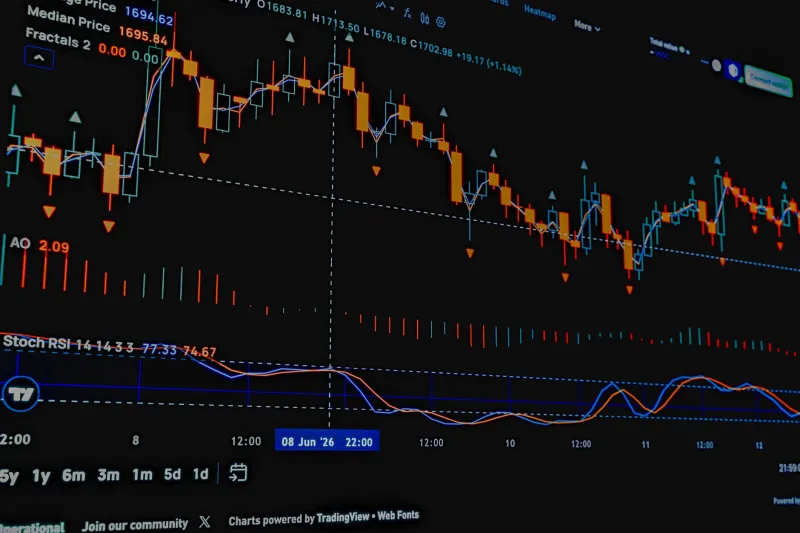
Photo by Photo by Taylor Vick on Unsplash on Unsplash
For the better part of the last decade, the dominant religion in algorithmic trading has been speed. Faster execution, lower latency, co-located servers, optimized network paths — these were the pillars upon which competitive advantage was supposedly built. In traditional equity markets, high-frequency trading firms spent hundreds of millions of dollars shaving microseconds off order transmission times. Crypto markets, once considered too young and fragmented to attract that level of infrastructure investment, have quietly undergone the same transformation.
The result is an environment where the latency arms race has effectively neutralized itself. When every serious participant in a market deploys agents capable of executing in the same narrow time window, the window ceases to be an advantage. It becomes a baseline requirement — the minimum cost of admission rather than a source of differentiated return.
For traders still architecting their strategies around raw speed, this shift carries significant consequences.
The Compression Problem
Execution windows in crypto markets have narrowed dramatically over the past three years. What once represented a meaningful arbitrage opportunity exploitable over several hundred milliseconds now closes in fractions of that time, often before a second-tier agent has even registered the signal. The proliferation of autonomous agents — deployed by institutional desks, proprietary trading firms, and increasingly sophisticated retail operators — has created a market microstructure where speed advantages are competed away almost as quickly as they are established.
This is not simply a theoretical concern. Portfolio data from multi-agent deployments consistently shows diminishing marginal returns on latency improvements beyond a certain threshold. Reducing execution time from 50 milliseconds to 10 milliseconds may produce measurable gains in specific, narrow-spread arbitrage contexts. Reducing it further, from 10 milliseconds to 2 milliseconds, frequently produces returns that are statistically indistinguishable from the baseline — while the infrastructure costs required to achieve that improvement are anything but marginal.
The hidden cost of chasing microsecond gains extends beyond direct infrastructure spending. Engineering resources devoted to latency optimization are engineering resources not devoted to signal development, risk modeling, or portfolio architecture. In an environment where execution speed is increasingly commoditized, that trade-off becomes increasingly difficult to justify.
What the Data Actually Shows
When execution speed is held roughly constant across competing agents — as it increasingly is in mature crypto markets — performance differentiation migrates upstream to signal quality. The question shifts from "how fast can my agent act on information?" to "how reliable and differentiated is the information my agent is acting on?"
This distinction matters enormously in practice. An agent executing a low-quality signal at two milliseconds will consistently underperform an agent executing a high-quality signal at fifteen milliseconds, particularly after accounting for transaction costs, slippage, and the compounding drag of frequent small losses. The mathematics of trading edge have not changed; only the variable that drives edge has shifted.
Signal quality encompasses several dimensions that speed-focused architectures tend to underinvest in. Data source diversity — drawing from on-chain activity, order book dynamics, cross-exchange flows, and macroeconomic indicators simultaneously — reduces the probability that any single corrupted or manipulated feed degrades overall signal integrity. Signal filtering, which involves distinguishing genuine market movements from noise, becomes increasingly valuable as market microstructure grows more complex. And signal timing, meaning the ability to identify not just the direction of a move but the optimal moment within a broader window to act on it, requires analytical sophistication that raw execution speed cannot substitute for.
Risk-Adjusted Positioning as the New Competitive Frontier
Beyond signal quality, the portfolios demonstrating the most durable performance in the current environment share a common characteristic: they have shifted their optimization target from gross return to risk-adjusted return. This is not a subtle distinction. A strategy that generates a 40 percent annualized return with a Sharpe ratio of 0.6 is, in most practical respects, inferior to one generating a 28 percent return with a Sharpe ratio of 1.4 — particularly for institutional participants managing drawdown constraints and investor reporting obligations.
Autonomous agents offer genuine advantages in this domain that extend well beyond what speed optimization can provide. A well-architected agent system can continuously recalibrate position sizing in response to evolving volatility regimes, adjust exposure across correlated assets in real time, and enforce risk limits with a consistency that human oversight cannot match. These capabilities compound over time in ways that latency improvements, subject to the diminishing returns described above, simply do not.
For US-based traders navigating markets that operate across time zones and around the clock, the risk management dimension is particularly consequential. Overnight exposure, weekend gaps, and liquidity dislocations during off-peak hours represent categories of risk that a speed-optimized agent with poor risk architecture will encounter repeatedly. A more deliberately constructed system — one that treats risk-adjusted positioning as a first-order design objective — handles these conditions more robustly.
Architectural Implications for Multi-Agent Deployments
The shift away from speed as the primary competitive variable has direct implications for how multi-agent portfolios should be designed and evaluated. Agents that were deployed primarily to capture latency-sensitive arbitrage opportunities may require reassessment as those opportunities compress. The question is not whether to use autonomous agents — their advantages in execution consistency, continuous operation, and data processing capacity remain substantial — but rather how to configure them for an environment where the source of edge has migrated.
Several architectural principles become more relevant under these conditions. Agent specialization by signal type, rather than by execution speed tier, allows a portfolio to capture differentiated opportunities across multiple market regimes. Coordination protocols that prevent agents from generating correlated execution clusters — which amplify slippage and erode the very advantages they were designed to capture — become more important as the number of deployed agents increases. And governance frameworks that allow for systematic strategy reassessment, rather than treating initial deployment configurations as permanent, enable portfolios to adapt as market microstructure continues to evolve.
The Smarter Move Forward
The agent arms race, defined by the relentless pursuit of faster and faster execution, has reached a logical conclusion. Speed remains necessary, but it is no longer sufficient. The traders and portfolio managers who recognize this transition early — and redirect their optimization efforts accordingly — are the ones positioned to extract durable advantage from the autonomous agent architectures they have built.
At 9Wickets Agent, the principle embedded in our positioning has always been that smarter moves outperform faster ones over any meaningful time horizon. In the current market environment, the data is increasingly confirming that premise. The next frontier in autonomous trading is not measured in milliseconds. It is measured in the quality of decisions made within whatever execution window the market provides.